The AI assistant
A chat that answers from documents you control, with a language model that runs on your own hardware. Nothing is sent anywhere: not the question, not the retrieved passage, not the answer.
Answers with a source, not a vibe
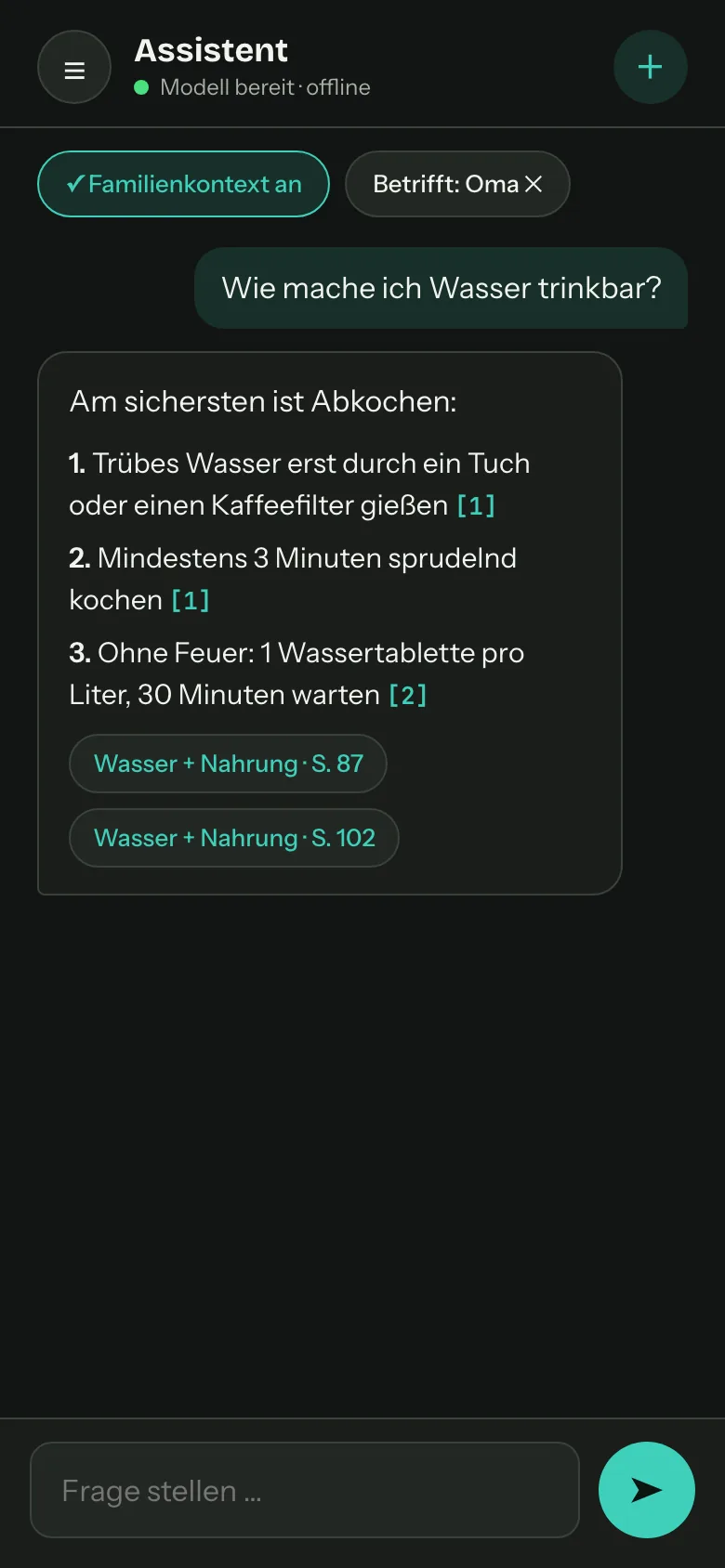
Every answer carries chips underneath it: document name and page. Tapping one opens the PDF at that exact page. If the documents do not cover your question, the assistant says so instead of inventing something, which for a first-aid question is the only acceptable behaviour.
Streaming, short, in plain language
Answers appear word by word as they are generated, so you can start reading immediately. They are deliberately short: steps, quantities, warnings. Long essays are not useful when you are holding a torch.
Foreign-language documents work
A German question against an English handbook returns a German answer. There is no translation step and no language pack. The retrieval is calibrated per language pair, and the prompt forbids the model from drifting into the language of the source. Imperial units are converted to metric with the original in brackets, because a mis-read gallon is a safety problem, not a cosmetic one.
Household context, when you want it
The assistant can take your medical cards into account ("does grandma's allergy matter here?"), and you can switch that context off per session. Medical answers always carry a static disclaimer.
It also knows the app
The handbook you are reading on this website ships inside the app as an indexed document. Asking "how do I book out half a pack?" gets the same treatment as a survival question: a short answer with a citation.
Library and your own documents
The library is the pile of knowledge the assistant is allowed to use.
- Import PDF, TXT and Markdown. Text is extracted, cleaned, split into sections and indexed. A 100-page PDF takes a few minutes once, then never again.
- PDF viewer with page jump. Reading the original is always one tap away.
- Language badge per document, detected automatically.
- Covers from page one, so a shelf of PDFs is recognisable at a glance.
- Honest errors. A scanned book without a text layer cannot be indexed. Keepilo says exactly that, in one sentence, instead of failing quietly.
- Re-index and delete, with a confirmation, because deleting a book you spent an evening importing should require a second of thought.
Keepilo does not ship copyrighted books. It points you at freely downloadable handbooks and lets you import them yourself, and it handles anything else you own the same way.
Inventory: food, water, medication, consumables
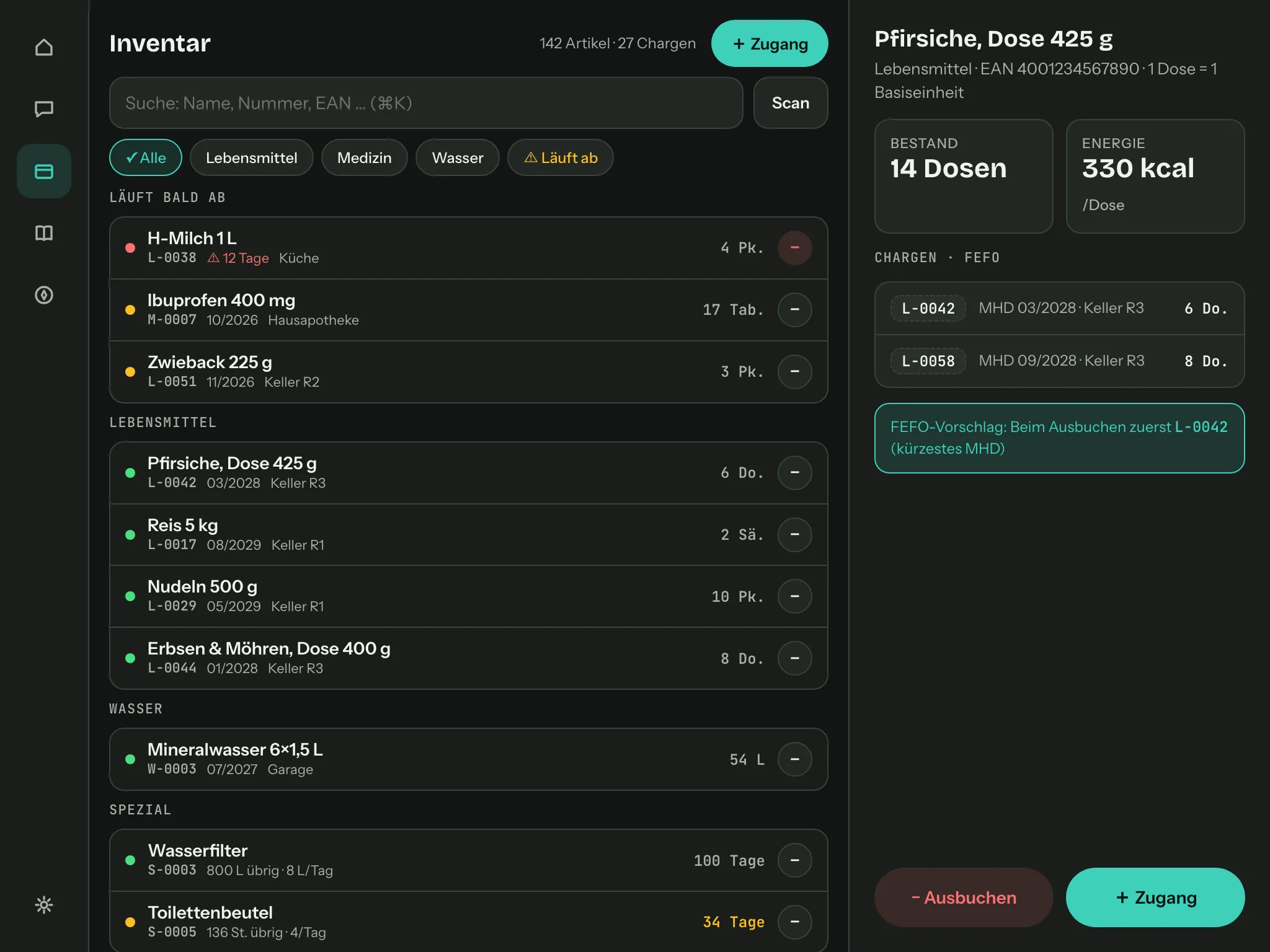
Booking in
A wizard, not a form wall: name, quantity, unit, best-before date, storage location.
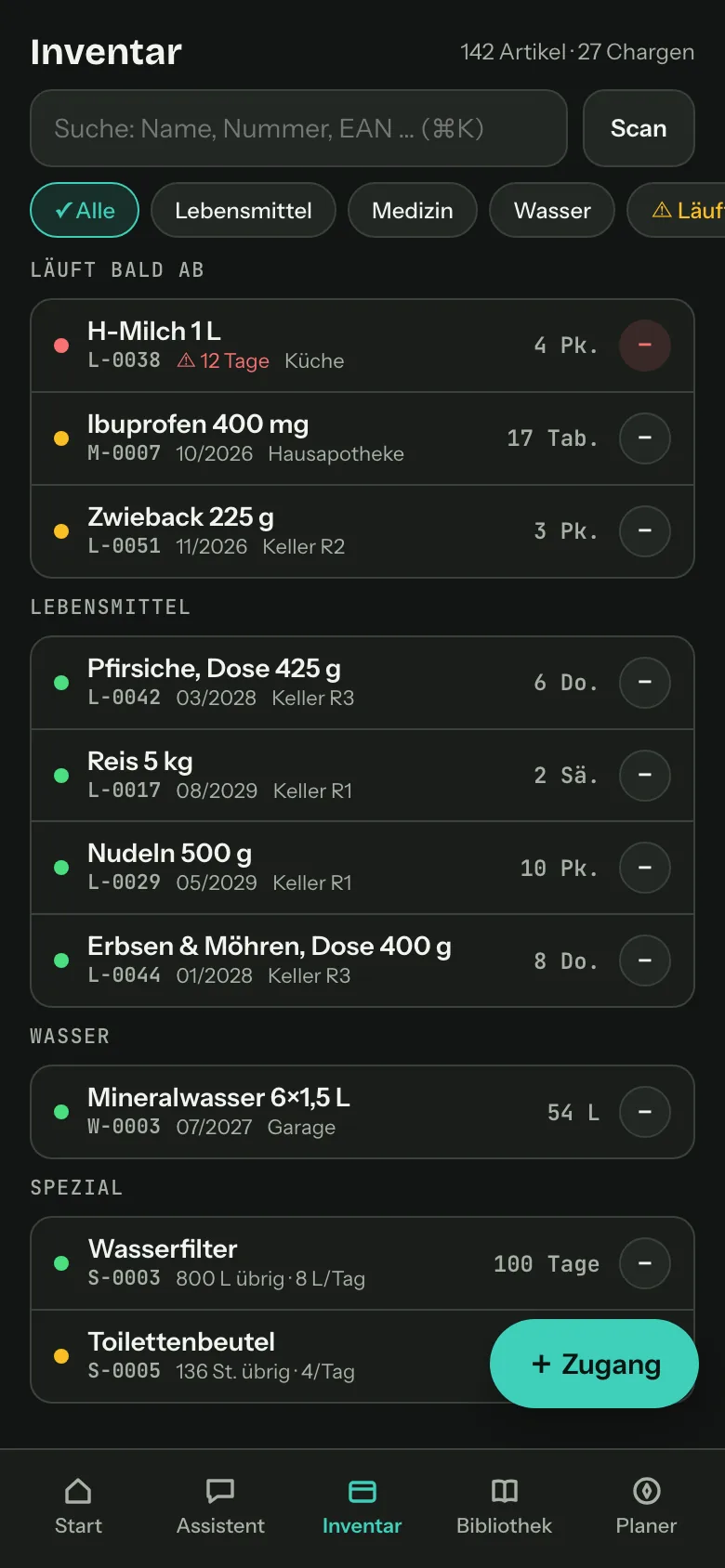
Barcode scanning on phones fills in what it can. Every article gets an inventory number
(L-0042 for food, M-0007 for medication, W-0003 for
water, S-0003 for special items) that you can write on the crate with a marker
and search for later.
Batches and expiry
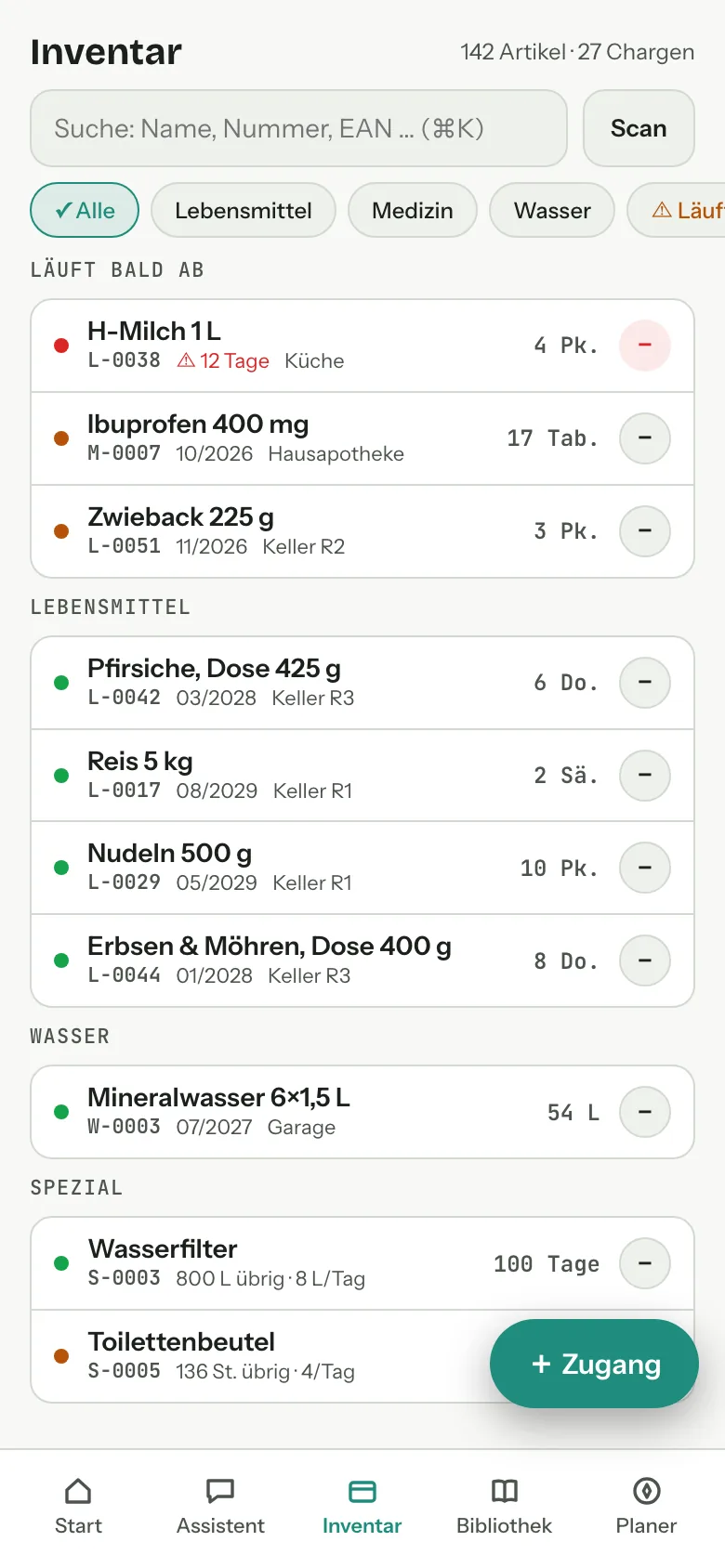
Identical goods with different best-before dates stay separate batches. The list shows a traffic light per item, groups what expires soon at the top, and the detail panel lists every batch with its date and location.
Booking out, including half a pack
Take out whole packs, partial quantities or the rest of a batch, with a reason (used, expired, given away, lost). Keepilo proposes the batch with the shortest date first, FEFO or first expired first out, because otherwise the oldest tin lives forever.
Special items with a real range
A water filter is not measured in pieces but in litres, a toilet bag in days, batteries in packs. Keepilo tracks capacity per model, measures the actual daily rate from your usage log and reports the range in days. Filter and purification tablet capacity counts as potential drinking water in the water calculation.
Nutrition
Energy and macronutrients per article feed the dashboard's balance view, so you can see that you have five months of pasta and eleven days of vegetables.
Dashboard: how long would we last?
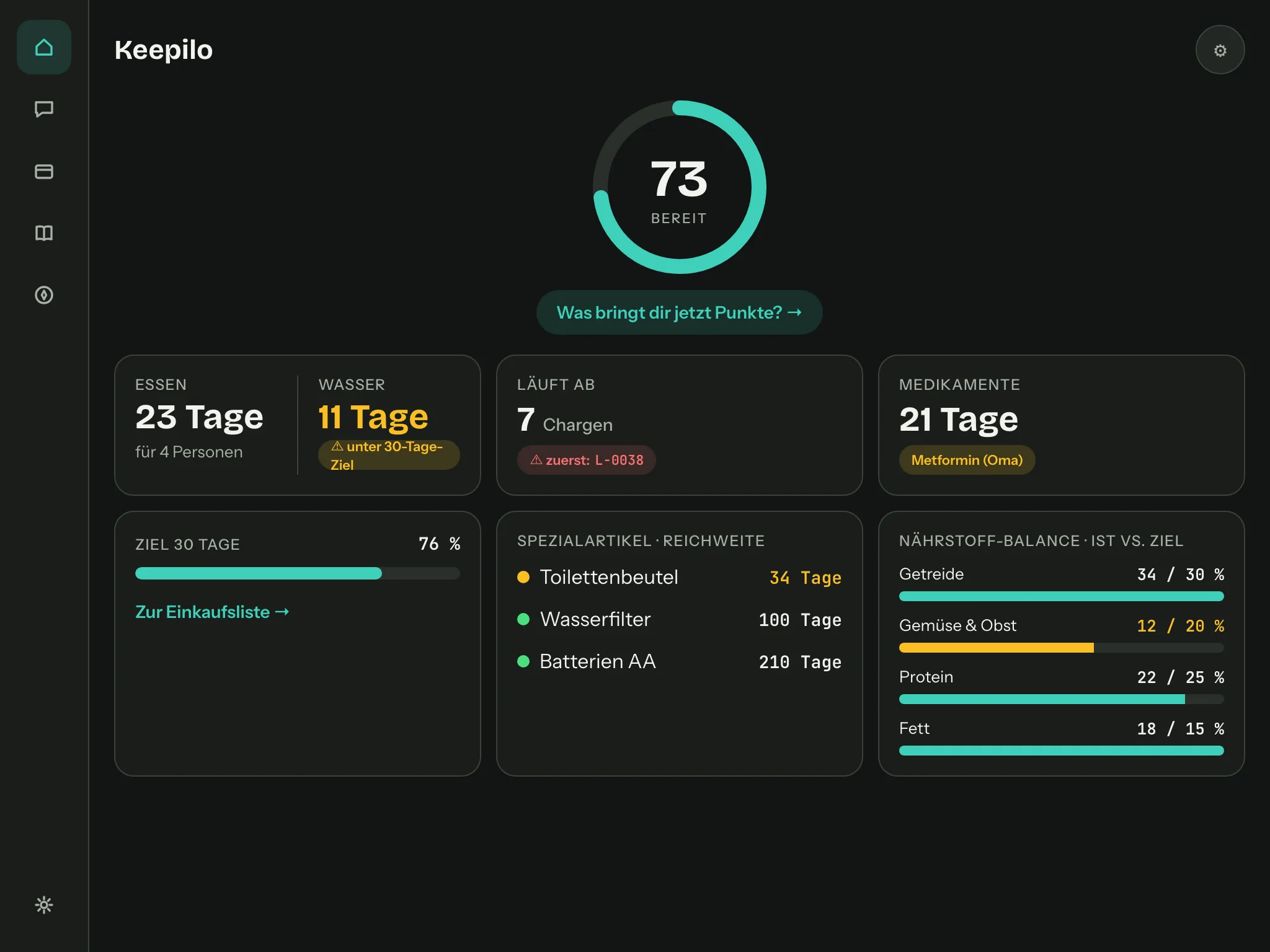
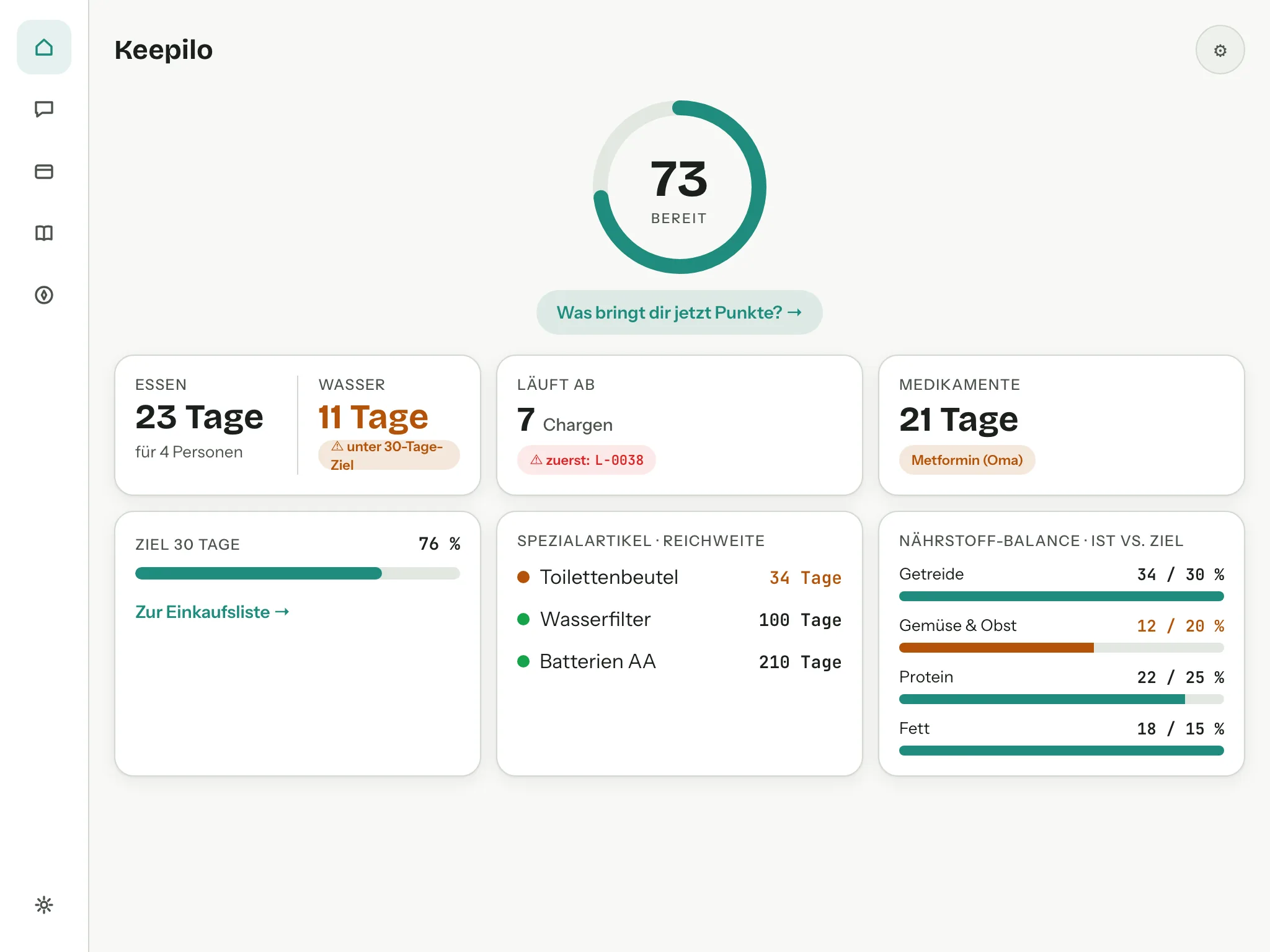
- Household with requirement profiles. Daily calorie and water requirement per age group and sex, with a per-person override when someone eats more, is pregnant or is an athlete. Every value shows where it came from: your override, the profile, or the general reference figure.
- Range in days for food and water, against your household, with a traffic light against the target you set (14 days, 30 days, whatever you decided).
- Expiring soon, with the batch that goes first named directly.
- Medication range per person, computed from the dosage in the medical card and the stock in the inventory. This is the number that quietly matters most.
- Nutrient balance: actual versus target share for grain, vegetables and fruit, protein and fat.
- Readiness score with one suggestion at a time: the single next thing that would improve your situation most.
- Local notifications: a weekly check and threshold alerts, scheduled on the device without a background service and without a push server.
Planner: rationing, shopping list, emergency
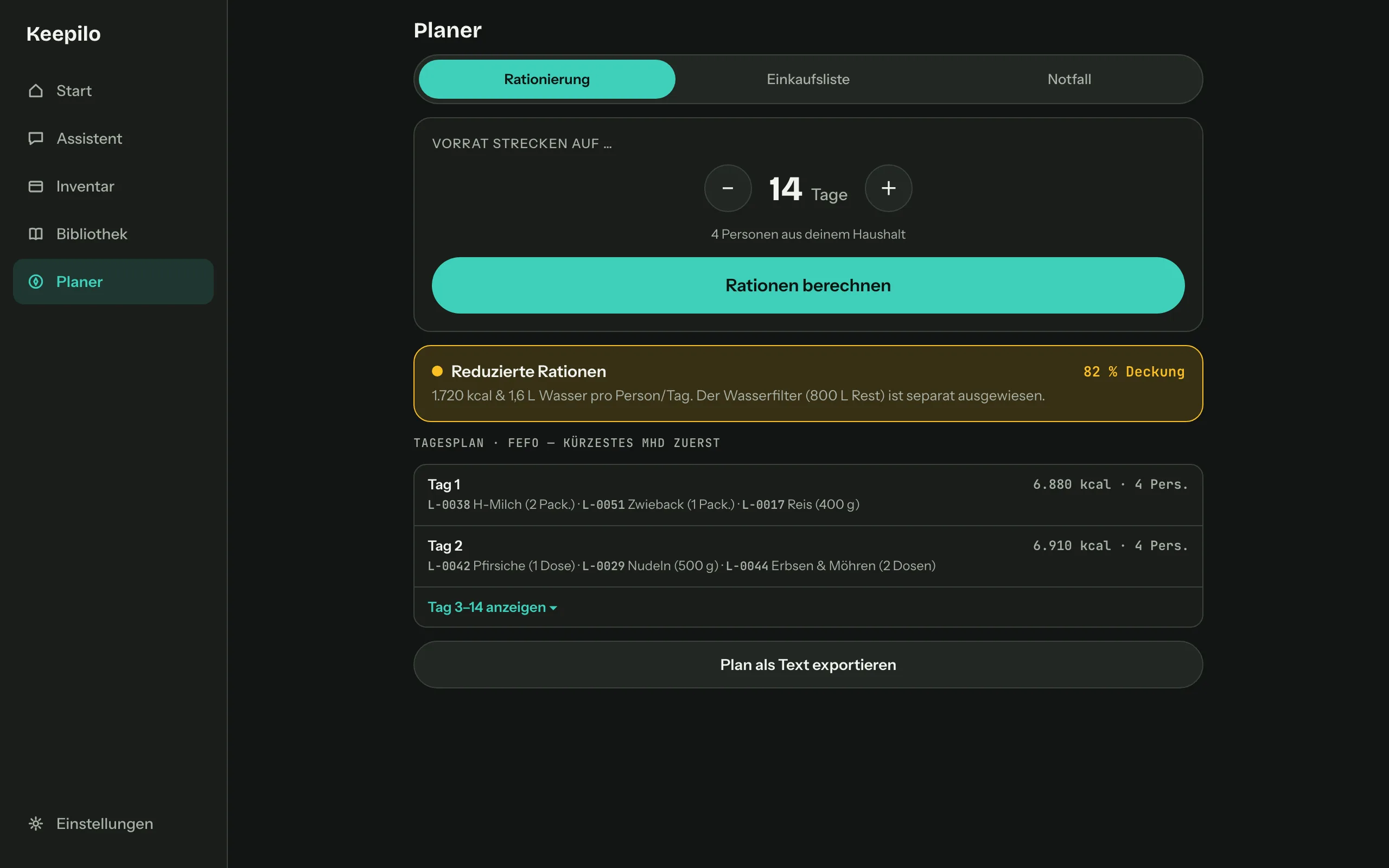
Rationing
Pick a number of days. Keepilo computes the coverage you would reach, tells you honestly if it is below 100 %, and produces a day-by-day plan that consumes the shortest-dated batches first and keeps every day within ±10 % of the same energy budget. Export as text to the clipboard or the share sheet.
Shopping list
The inverse calculation: the gap between where you are and where you want to be, in water, calories and long-term medication. Suggestions come from a template table, the list is tickable, and it shares as plain text so it survives any messenger.
Emergency tab
The emergency plan (free text: meeting points, contacts, who picks up the children), the emergency backpack checklist, and the emergency cards.
Emergency area
- Emergency button and full-screen emergency mode: large type, high contrast, the essentials only: plan, contacts, medical cards.
- Notify the family via SMS, because SMS gets through when data does not.
- Emergency backpack checklist based on the recommendations of the German Federal Office of Civil Protection and Disaster Assistance (BBK), written in our own words, tickable per person, contributing to the readiness score.
- Printable emergency cards: A7 landscape, four to an A4 sheet, with cut marks and mirrored backs so double-sided printing lines up. Photo, blood type, allergies, chronic conditions, medication, emergency contact.
Medical cards
One card per person: blood type, height and weight, allergies, chronic conditions, vaccinations, long-term medication with dosage. The medication entries link to the inventory, which is what makes the range calculation possible. The card is filled in by a wizard (one question per screen, skippable, resumable) and it can be shared or printed.
This is health data under Article 9 GDPR. It lives in the same local database as everything else, is never transmitted, and the export preset that contains it asks before it does.
Security and app lock
- PIN, stored as a PBKDF2 hash in the system keychain, never in plain text.
- Biometrics: Face ID, Touch ID, fingerprint, Windows Hello.
- Auto-lock after a chosen idle time.
- Snapshot protection: the app preview in the task switcher is blurred, so a shoulder glance does not reveal the medication list.
Backup, export and offline family sharing
Everything is in one file format, .keepilo, with presets that decide what goes
in: full backup, inventory only, or a sharing package that deliberately excludes or includes
health data and asks you first.
- Automatic local backup: daily, three generations kept, without the PDFs so it stays small.
- Export and import through the operating system share sheet: AirDrop, Quick Share, USB stick, email to yourself.
- Direct transfer over local Wi-Fi: the sending device opens a small local web server with a one-time token, shows a QR code, and the receiving device scans it and downloads. The token is valid for exactly one transfer and is handed over by camera, outside the network. Works on a hotspot with no internet behind it.
- "Open with Keepilo" for backup files and library documents from other apps.
- Merge rules so importing does not silently overwrite what you built.
Platforms and layout
One codebase, three layouts, four platforms.
| Class | Width | Navigation | Detail view |
|---|---|---|---|
| Phone | under 600 dp | Bottom bar, five entries | Full screen, pushed |
| Tablet | 600-1024 dp | Icon rail on the left | Side panel |
| Desktop | over 1024 dp | Sidebar with labels | Third column |
The design system behind it is called "calm strength": warm dark surfaces, high contrast, a single petrol accent, and traffic-light colours reserved strictly for status, never decoration. Every touch target is at least 48 px.
Dark and light are equal citizens
Keepilo follows your system setting, and both modes are designed rather than derived. In light mode the accent and the status colours go a step darker so text keeps its contrast on paper; nothing is a washed-out version of the other mode.